Why a Heavy Pan Holds Its Heat
Why a heavy pan holds its heat: understand how material and mass shape cooking response, then choose a pan that suits your stove and cooking habits.
You add a piece of cold fish to a pan, and the steady sizzle fades to a weak hiss. A heavy pan often recovers more steadily because it stores heat, but that same reserve can make it slow to respond when the burner is turned down. Understanding why a heavy pan holds its heat helps you distinguish a useful cooking trait from a pan that is simply cumbersome.
Heat in the pan
Heat capacity is the amount of energy a material can absorb as its temperature rises. A pan’s total heat capacity depends on both its material and its mass: a larger amount of metal can store more energy than a thinner amount of the same metal. This stored energy can help the cooking surface resist a sudden temperature drop when food goes in.
Heat capacity is not the same as heat conductivity. Conductivity describes how readily heat moves through a material. Copper and aluminium conduct heat readily; stainless steel conducts it less readily. A pan’s construction brings these properties together: a stainless-steel body with an aluminium or copper core behaves differently from a single layer of stainless steel.
Think of stored heat like water in a bucket. A larger bucket can supply more before it empties, but it also takes longer to fill. In a pan, the “bucket” is its material and mass, while the burner supplies heat and the food draws it away.
Sudden cooling
Problem: The sizzle dies when you add food, and the ingredients begin to steam or release liquid rather than sear. Usual cause: The food is drawing heat from a cooking surface that cannot supply energy as quickly as the temperature falls. A lightweight pan has less stored heat to draw on; a crowded pan adds more cold, moist food at once.
Try this, in order:
- Pat ingredients dry where the recipe allows, especially meat, mushrooms and vegetables with a damp surface.
- Cook in smaller batches so the pan is not covered all at once. Leave space for moisture to escape.
- Let the pan preheat before adding food, using a moderate setting rather than turning the burner to its highest setting by default.
- If the problem continues with your usual batch, try a heavier pan or a smaller quantity of food per batch.
A heavy pan can help with recovery, but it cannot prevent cooling altogether. The food still needs contact with the hot surface, and a pan that is crowded or poorly matched to its burner can lose heat unevenly.
Uneven cooking
Problem: One part of the food browns quickly while another remains pale. Usual cause: The pan has hot and cool zones, or the burner’s heat does not spread evenly across its base. Mass alone does not correct either issue. A thick pan may smooth small changes, yet a warped base or a burner that is narrower than the pan can still produce an uneven result.
Try this, in order:
- Check whether the pan sits flat on the hob and whether its base broadly suits the burner’s size.
- Move food through the pan during cooking if the dish allows it, rather than leaving every piece in the same hot spot.
- Use a pan with a layered base or a material suited to the hob if heat distribution remains troublesome.
Material names do not tell the whole story. Aluminium spreads heat readily, while stainless steel is often used as an outer cooking surface for durability and compatibility with different tasks. Clad cookware combines layers, so its behaviour depends on the arrangement and thickness of those layers as well as the overall mass.
Slow temperature changes
Problem: The pan stays hot after you lower the burner, and delicate food keeps cooking faster than intended. Usual cause: Stored heat is being released after the burner setting changes. A heavy pan has more thermal inertia: its temperature changes more slowly, in either direction.
Try this, in order:
- Lower the heat before the food reaches its final stage, allowing for the pan’s gradual response.
- For a recipe that needs a quick temperature adjustment, lift the pan briefly from the heat if it is safe and practical to do so.
- Use a lighter pan for food that needs rapid changes, such as a delicate sauce, if that suits the recipe and your equipment.
That slower response can be helpful for steady simmering or for keeping a pan’s temperature from swinging sharply when ingredients are added. It is less convenient when a dish depends on an immediate change. Choose for the cooking task rather than assuming that maximum mass is always preferable.
Sticking and scorching
Problem: Food sticks, or the bottom scorches before the rest is ready. Usual cause: The pan may be too hot, the heat may be concentrated in one area, or the food may have been moved before it had time to release. Weight is only one part of the picture; it does not replace suitable heat control or the right surface for the food.
Try this, in order:
- Start with a lower setting and give the pan time to warm rather than heating it aggressively.
- For stainless steel, allow the surface and cooking fat to warm before adding food, then avoid forcing food loose if it has not yet released.
- For a sauce or other delicate mixture, stir and adjust the heat as needed; a pan that stores heat may continue cooking even after the burner is reduced.
- If sticking persists, consider whether a non-stick, enamelled or seasoned surface better suits that particular job.
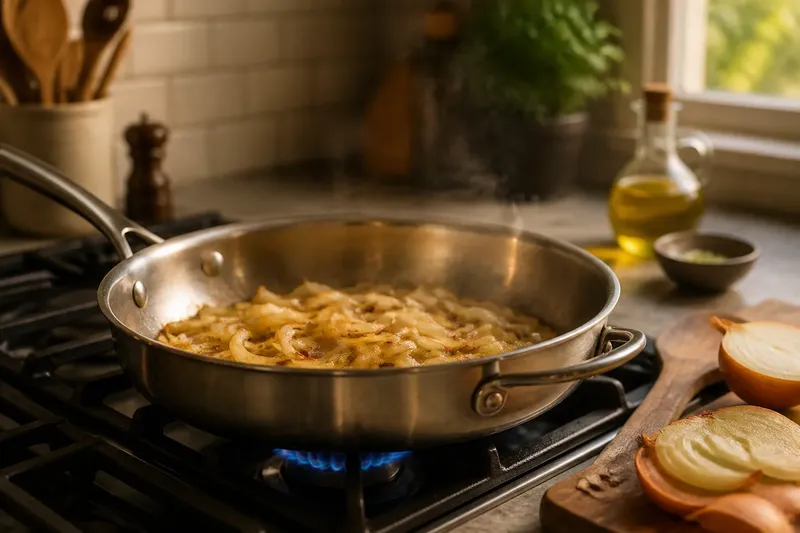
Imagine you are cooking onions in a thick stainless-steel sauté pan and they begin to darken at the edges before softening throughout. Lower the burner, stir the onions and move the pan off the heat briefly if they continue to colour; the expected observable result is slower browning while the pieces cook more evenly, rather than a sudden stop in cooking.
Choosing useful weight
Compare pans by construction and intended use, not by heft alone. A heavy cast-iron pan can store substantial heat and suit foods that benefit from a steady cooking surface, while its weight and slow response may feel awkward for frequent tossing. A lighter aluminium pan can respond more quickly, though its performance depends on its base and construction. Stainless-steel pans vary widely, especially when they have conductive layers beneath the cooking surface.
Consider how the pan will be handled as well as how it cooks. A full pan is heavier than an empty one, so lifting and pouring matter. A broad, flat base may be useful on one hob but not another. If you cook quick, delicate dishes, responsiveness may matter more than stored heat; if you often add cool ingredients in batches, a heavier build may be welcome.
For cookware compatibility, care and safe handling, follow the pan maker’s instructions and the requirements of your hob; ask a qualified professional if a fitting or equipment issue is unclear.
Pan heat questions?
Does a heavier pan always cook better?
No. Greater mass can help a pan resist cooling when food is added, but it can also make the pan slower to heat and cool. The best choice depends on the food, the burner and how easily you want to handle it.
Why does my heavy pan still cool down?
Any pan cools when cold or wet food draws energy from it. A heavy pan may lose heat more gradually, but crowding, a small burner or a large amount of food can still overwhelm its stored heat.
Is cast iron the only heat-holding option?
No. Thick aluminium and layered stainless-steel cookware can also store heat, though their conductivity and response differ. Look at the pan’s construction and how it suits your cooking rather than relying on the material name alone.
When is a light pan preferable?
A lighter pan can be easier to lift and can respond more promptly when you change the heat. That can suit quick cooking or dishes that need frequent movement, while a heavier pan may suit steadier cooking.
When a pan behaves differently from what you expect, ask whether the trouble comes from heat storage, heat distribution or response time. That distinction makes it easier to choose a remedy—and to decide whether a heavier pan would actually help.